
News

Handbook on Welfare State Reform published

The Handbook on Welfare State Reform edited by Bernhard Ebbinghaus and Moira Nelson is now published by Elgar; it combines 28 chapters by experts discussing theories, methods, policy areas and societal trends relevant for studying welfare state reforms.

Ebbinghaus, Bernhard and Moira Nelson (eds.): Handbook on Welfare State Reform, Cheltenham, UK: Edward Elgar, August 2025, Elgar Handbooks in Social Policy and Welfare series, ISBN: 978 1 83910 879 2 (cased) / 978 1 83910 880 8 (eBook)
[Introduction and Table of Contents], 442 pages [discount flyer]
This comprehensive Handbook examines the capacity of advanced welfare states to adapt to sustained pressures and unforeseen crises. It explores the enduring relevance of established frameworks in explaining welfare state change as well as their effectiveness in addressing essential areas for reform.

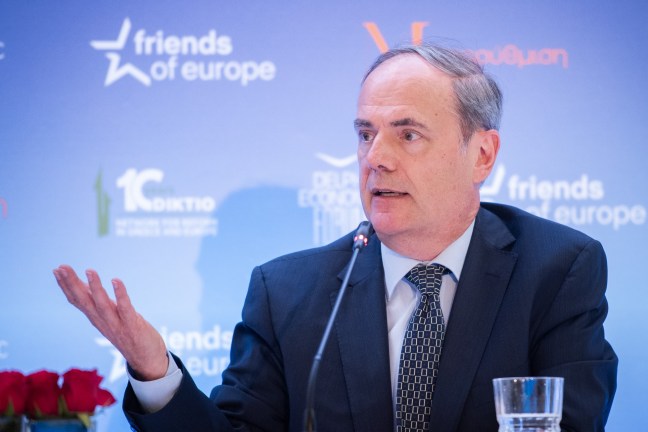
Discussing social protection for all at Social Europe Conference

At the Social Europe conference in Berlin, Professor Ebbinghaus discussed the report of the EU High-Level Group on the “Future of Social Protection and the Welfare State in Europe” in respect to old age security, The best pension policy is to pursue social investment early over the life course and an inclusive employment strategy combined with social protection for all. The Report argues for a social investment approach that “starts strong” during early childhood and subsequently promotes equal opportunities in education. Such an inclusive approach needs then to continue throughout the working life and leading with an active ageing strategy into old age with adequate pensions, health and long-term care provision. In order to avoid old age poverty it is necessary to increase labour market integration broadly and include all in contributing to pensions, whether via public insurance or supplementary savings. Professor Ebbinghaus argues that the best pension policies need to start early with investing in education and inclusive labour market policies, the multiplier effects of such a social investment strategy, together with more inclusive employment and protection for all, will make pension systems more sustainable in financial terms but also socially more just. It will also increase the trust in intergenerational solidarity if we combine both social investment and inclusive protection.    

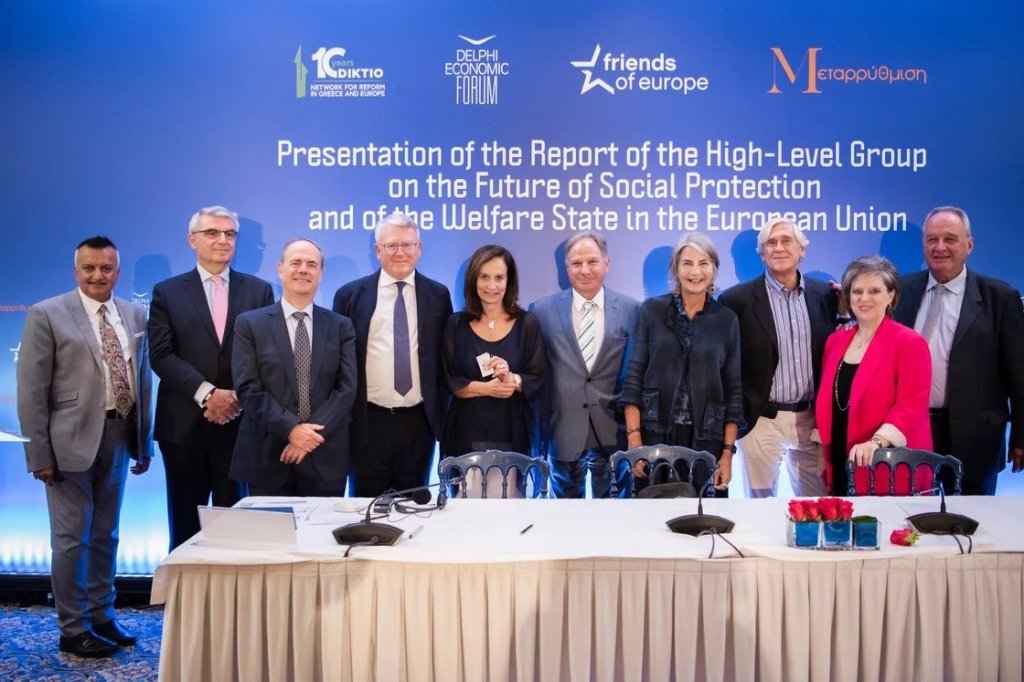
Presentation of EU report in Athens

As part of the Athens presentation of the EU Report on the Future of Social Protection & the Welfare State in the EU of the High Level Group chaired by Anna Diamantopoulou, Professor Bernhard Ebbinghaus discussed the two main goals to provide social secruity for all and how to apply a life-course social investment strategy. Given the mega-trends of flexible work, digitalization, and green transition, European welfare states should aim at social security for all, including the atypical employed, platform workers, and self-employed. Also population ageing and migration shifts make it necessary to increase overall employment and raise the pension age with life expectancy. Professor Ebbinghaus argued the need to invest early in young people and foster their indepenence, helping them master the new world of work. Furthermore, continued VET, work-family reconciliation, and active ageing policies are crucial to achieve the goals of full employment. In the precence of HE the president of the Hellenic Republic, EU Commissioner Schmit and the Greek labour minister, the deliberations in Athens centred on the situation in Greece and how to apply the 21 recommendations of the EU report (europa.eu/!dXybFh).

Social sustainability: towards adequate pensions

Professor Ebbinghaus discusses the imporantce of social sustainability in pension reforms at the conference Public pension systems: changing narratives, changing realities? at CEPS in Brussels on 23 March 2023. The High Level Event in cooperation with the Spanish Ministry of Inclusion, Social Security and Migration brings policy makers and experts together. In his intervention he considers implications of pension reforms based on his findings from a comparative analysis of poverty and inequality in old age across Europe. It is important to apply a life-course approach as adapted in the High-Level Group Report on the Future of Social Protection and the Welfare State in the EU published in February 2023. (See slides of presentation)

Wiener Polanyi Vortrag zu Resilienz des Sozialstaates nun als Video

Mein Vortrag zu “Die Resilienz des Sozialstaates als Gegenbewegung in Europas Wirtschaftskrisen” als Karl-Polanyi-Gastprofessor an der Universität Wien ist nun online as Video verfügbar. Aufzeichnung der ersten Stunde des Vortrag und dann der öffentliche Diksussion (Moderation: Prof. Kittel) in der Urania, Wien. Die Folien des Vortrages können als PDF heruntergeladen werden.

Professor Bernhard Ebbinghaus, Vortrag und Diskussion, Urania Wien, 18. Jan. 2023

Report on the Future of European welfare states

As member of the High-Level Group of the European Commission, Professor Ebbinghaus contributed to the report on the Future of Social Protection and the Welfare State in the EU, which was launched on 7 Feburary 2023 in Brussels. The expert group, chaired by former European Commissioner for Employment, Social Affairs and Equal Opportunities, Anna Diamantopoulou, looked at ways to reinforce social protection both at national and European levels to respond for instance to demographic change, the impact of new forms of work, and the digital and green transitions. Commissioner for Jobs and Social Rights, Nicolas Schmit, and the ministers from Belgium, Sweden, and Spain as well as other policymakers and stakeholders attended the conference to discuss the policy implications of the report. Professsor Ebbinghaus explained the recommendations on social protection for all and its funding on a panel, highlighting the need to close access gaps for those with flexible jobs and performing non-standard work, while also extending funding for the welfare state with a broader, fairer mix of revenue sources.

Nomination as Karl Polanyi Visiting Professor

In January 2023, Prof. Bernhard Ebbinghaus will be the fourth Karl Polanyi Visiting Professor at the University of Vienna. As kick-off, he will hold a public lecture (in German) on welfare state resilience as a countermovement in economic crises.  He will hold a Graduate Seminar at the University of Vienna and a workshop at the Central European University (CEU), both dealing with crisis reactions and adjustments of welfare states in Europe in the field of labour market and social policy.

Vacancy at Uni Mannheim: Assistant Professorship – Sociology of Welfare States

The School of Social Sciences of the University of Mannheim has a vacancy for an assistant professorship (Juniorprofessur, W1) in the areas of welfare state research from August 2023 for up to six years. Postdocs with research and teaching experience in comparative sociology, in particular the analysis of welfare states, are invited to apply by 24 November 2022. Teaching comprises German taught B.A. Soziologie (Aufbaumodul „Europäische Gesellschaften“) and English taught M.A. Sociology. Close cooperation with the Chair of Macrosociology, Prof. Ebbinghaus, and research at the Mannheim Centre for European Social Research (MZES) are expected. More information (in German): PDF

Prof Ebbinghaus returning to University of Mannheim

Since January 2022, Bernhard Ebbinghaus is Professor of Sociology in the School of Social Sciences at University of Mannheim, Germany. After five years at University of Oxford, he returns to the Chair of Macrosociology teaching comparative sociology in the Mannheim sociology (BA, MA, PhD) programmes and he continues his research on the reforms of European welfare states, facilitated by the Mannheim Centre for European Social Research (MZES)

During his five years at Oxford, he was Professor of Social Policy and Senior Research Fellow of Green Templeton College at University of Oxford from January 2017 until December 2022. From October 2017 until December 2020, Prof Ebbinghaus was Head of the Department of Social Policy and Intervention (DSPI) at University of Oxford. In addition, he is currently Associate Member of Nuffield College, University of Oxford.

He has been visiting Mercator Fellow (2018-21) at the Collaborative Research Centre (SFB 884) Political Economy of Reform and MZES External Fellow, University of Mannheim. In 2021 Prof Ebbinghaus was on sabbatical, working on the projects at University of Mannheim and visiting as OxPo Fellow the European research centre (CEE) at Sciences Po Paris. Since November 2021 Professor Ebbinghaus is member of the European Commission’s High-Level Group on the future of social protection and of the welfare state in the EU.