Discussing social protection for all at Social Europe Conference

At the Social Europe conference in Berlin, Professor Ebbinghaus discussed the report of the EU High-Level Group on the “Future of Social Protection and the Welfare State in Europe” in respect to old age security, The best pension policy is to pursue social investment early over the life course and an inclusive employment strategy combined with social protection for all. The Report argues for a social investment approach that “starts strong” during early childhood and subsequently promotes equal opportunities in education. Such an inclusive approach needs then to continue throughout the working life and leading with an active ageing strategy into old age with adequate pensions, health and long-term care provision. In order to avoid old age poverty it is necessary to increase labour market integration broadly and include all in contributing to pensions, whether via public insurance or supplementary savings. Professor Ebbinghaus argues that the best pension policies need to start early with investing in education and inclusive labour market policies, the multiplier effects of such a social investment strategy, together with more inclusive employment and protection for all, will make pension systems more sustainable in financial terms but also socially more just. It will also increase the trust in intergenerational solidarity if we combine both social investment and inclusive protection.    

Rethinking the role of state pension (TUC pension conference 2021 panel)

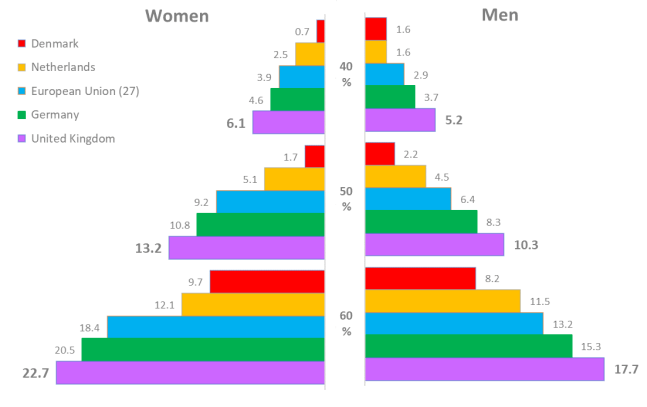
The Trades Union Congress (TUC) discussed the role of the state in the public-private pension mix in its TUC pension conference (fourth day) 2021. Professor Ebbinghaus contributed a presentation, “Inequalities & Poverty Risks in Old Age across European Pension Systems“, discussing the United Kingdom in comparative perspective. Comparing poverty rates across Europe, the British pension system has higher poverty rates compared to the Danish or Dutch basic pension systems but also the EU average or Germany. While in Bismarckian social insurance systems, poverty reduction is a secondary policy goal, some are able to reduce poverty through social pensions and compensating for gaps in contributions. In Beveridgean multipillar pension system, the primary goal is to provide a public basic pension for all residents, though its efficacy depends on its generosity, whereas the important private supplementary pension pillars increase inequality. The role of the state pension thus needs to be understood in the context of the overall architecture of the public and private pension system in the light of the goal to reduce poverty and inequality in old age.

Presentation (PDF) at TUC pension conference, 18 March 2021, 1 pm.

Multiple Hidden Risks for Older People: The Looming Pension Crisis Following this Pandemic

Journal of European Social Policy (JESP) Blog, 04/30/2020, by Bernhard Ebbinghaus, https://t.co/YZwYYcOZsy?amp=1
  • Every fourth person in Europe receives an old age, survivor or disability pension benefit, an automatic stabilizer during this crisis
  • Public pay-as-you go pension will soon come under severe pressure due to fiscal pressures accelerated during this pandemic
  • Private funded pensions with their additional risks, were hit hard after the 2008 crash and will again increase inequalities in old age in coming years
  • Older people transitioning from work to retirement will face immediate difficulties that need to be addressed