After five years as Professor of Social Policy and Head (2017-21) of the Department of Social Policy & Intervention at University of Oxford, Bernhard Ebbinghaus returned as Professor of Sociology to the University of Mannheim, leading the Macrosociology Chair at the School of Social Sciences as of January 2022. He will continue teaching comparative sociology and conducting research on welfare state reforms in Europe. Over the last twelve years he had been co-PI in the joint research centre Political Economy of Reform (SFB884) and had recently completed a project on Crisis Corporatism or Corporatism in Crisis at the Mannheim Centre for European Social Research (MZES).
The newly launched High-Level Group on the future of social protection and of the welfare state in the EU was launched on 16 November 2021 at the European Commission in Brussels. The Group will present recommendations on how to make social protection and welfare systems fit for the future. Professor Ebbinghaus is one of the twelve members of the High-Level Group advising the European Commission.
New LSE EUROPP Blog by Bernhard Ebbinghaus and Lukas Lehner
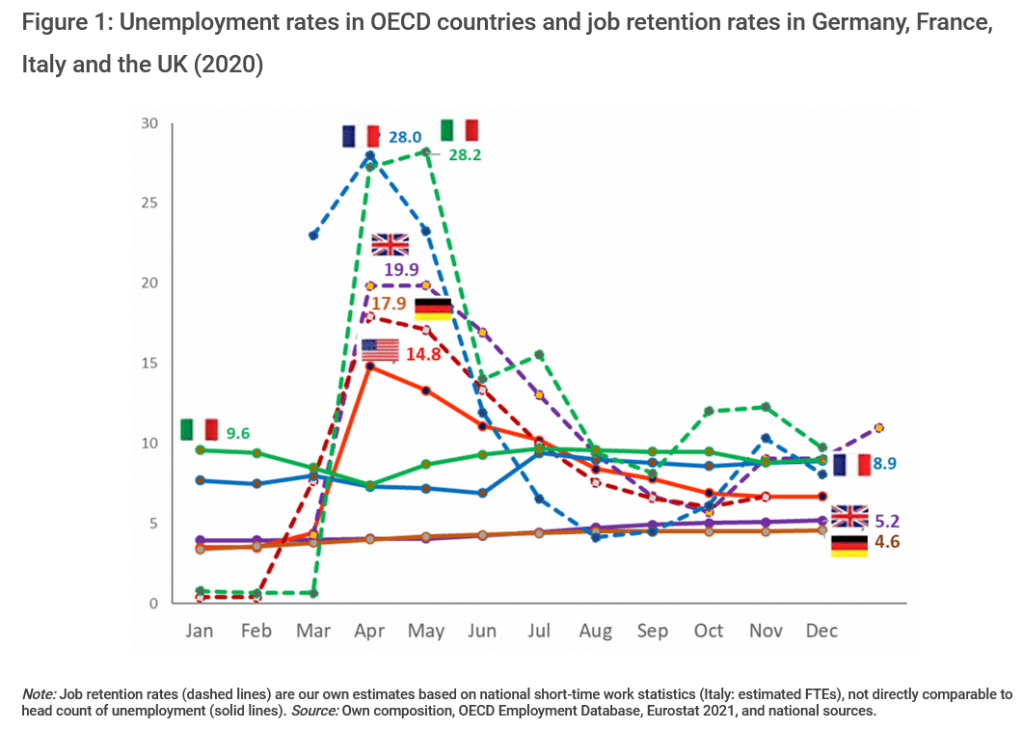
Job retention schemes have helped Europe to avoid mass unemployment during the Covid-19 pandemic. Bernhard Ebbinghaus and Lukas Lehner write that while these schemes had an immediate impact during lockdown, the future development and long-term consequences of job retention policies remain uncertain.
While the sustainability of pension systems facing demographic ageing has been widely discussed, the adequacy of retirement income has often been neglected in current debate. However, considerable poverty and income inequality in old age exists across Europe. Using recent EU‐SILC data (2017/18), the comparative analysis of poverty rates and income inequality in old age shows important cross‐national variations that need to be seen in context of market‐related inequalities but also the specific pension system. Beveridge basic security is not always capable of effectively reducing poverty despite the explicit goal to do so. In addition, private funded pensions may generate social inequality. Some contributory Bismarckian systems are better suited to reduce poverty, but given their focus on status maintenance also reproduce inequality. Poverty rates are low due to encompassing basic pensions in Dutch and some Nordic multipillar systems and in core Central and Eastern European countries. Bismarckian pensions such as in Germany are generating some inequality and medium level of poverty, while France and some Southern European countries perform better on poverty but reproduce larger inequalities. Beveridge systems such as in the United Kingdom and Switzerland with rather meagre basic multipillar systems have relatively medium to high poverty risks. In addition, the Baltic countries and new EU member states in the periphery have the highest poverty rates across Europe. The analysis shows that the minimum income provision of public pension systems matters most for poverty risks, while the overall pension architecture has an impact on reproducing inequality in old age acquired during working life.
Part of a special issue: Inequalities in pension and retirement: Life‐courses and pension systems in comparative perspective, Social Policy & Administration, 55(3), May 2021, edited by Kati Kuitto, Susan Kuivalainen, and Katja Möhring. https://onlinelibrary.wiley.com/toc/14679515/2021/55/3
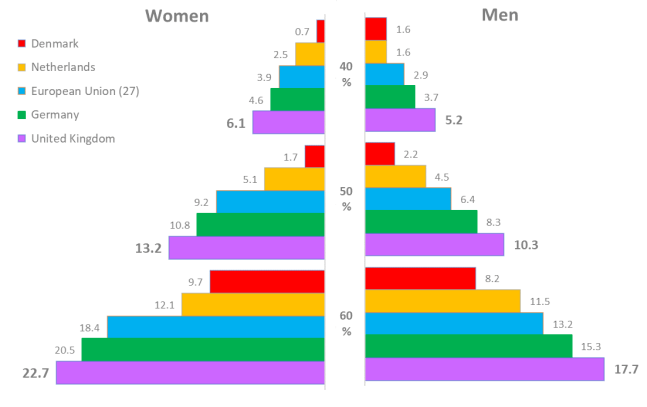
The Trades Union Congress (TUC) discussed the role of the state in the public-private pension mix in its TUC pension conference (fourth day) 2021. Professor Ebbinghaus contributed a presentation, “Inequalities & Poverty Risks in Old Age across European Pension Systems“, discussing the United Kingdom in comparative perspective. Comparing poverty rates across Europe, the British pension system has higher poverty rates compared to the Danish or Dutch basic pension systems but also the EU average or Germany. While in Bismarckian social insurance systems, poverty reduction is a secondary policy goal, some are able to reduce poverty through social pensions and compensating for gaps in contributions. In Beveridgean multipillar pension system, the primary goal is to provide a public basic pension for all residents, though its efficacy depends on its generosity, whereas the important private supplementary pension pillars increase inequality. The role of the state pension thus needs to be understood in the context of the overall architecture of the public and private pension system in the light of the goal to reduce poverty and inequality in old age.
One topic hardly mentioned during the last three years of Brexit negotiations is indeed among the most consequential—pensions. This is paradoxical because older British voters, who were more in favour of Brexit than other age groups, are likely to suffer most, as Brexit drives British social policy towards market liberalism and reshapes financialisation in the UK and indirectly across Europe, with considerable implications for pensions and inequality in old age. Bernhard Ebbinghaus discusses three paradoxical implications of Brexit on pension policy in the UK and Europe in a chapter in Whither Social Rights in (Post-) Brexit Europe? Opportunities and Challenges.
The Oxford COVID-19 ‘Supertracker’ is an online platform established to help policy-makers around the world to navigate the policy responses to tackling the pandemic, and its aftermath around the world.
Numerous organisations have produced trackers to allow policy-makers and stakeholders to follow and evaluate policy changes and their impact on the pandemic in the UK, Europe and across the world. The Oxford ‘Supertracker’ project makes this information freely available with one tool, allowing users to search and identify international policy.
What started out in March as a Twitter thread by DPhil student Lukas Lehner has evolved into a new global directory compiling over 100 data sources. Within a few weeks, thousands of researchers from over 100 countries around the globe visited the first iteration of the website, making use of the directory and contributing to the growing number of entries. The project is led by Dr Marek Naczyk, with the involvement of Professor Mary Daly, Professor Bernhard Ebbinghaus, Lukas Lehner and Dr Tim Vlandas.
This novel collection is designed to assist researchers and policy-makers in keeping track of a rapidly growing number of data sources. Compiling policy trackers and surveys, the tool allows users to search by: policy area e.g. ‘education policy’ or ‘social and economic policy’; country coverage; data format; and, author. In addition, the data summary can be downloaded as a CSV for offline analysis.
Every fourth person in Europe receives an old age, survivor or disability pension benefit, an automatic stabilizer during this crisis
Public pay-as-you go pension will soon come under severe pressure due to fiscal pressures accelerated during this pandemic
Private funded pensions with their additional risks, were hit hard after the 2008 crash and will again increase inequalities in old age in coming years
Older people transitioning from work to retirement will face immediate difficulties that need to be addressed
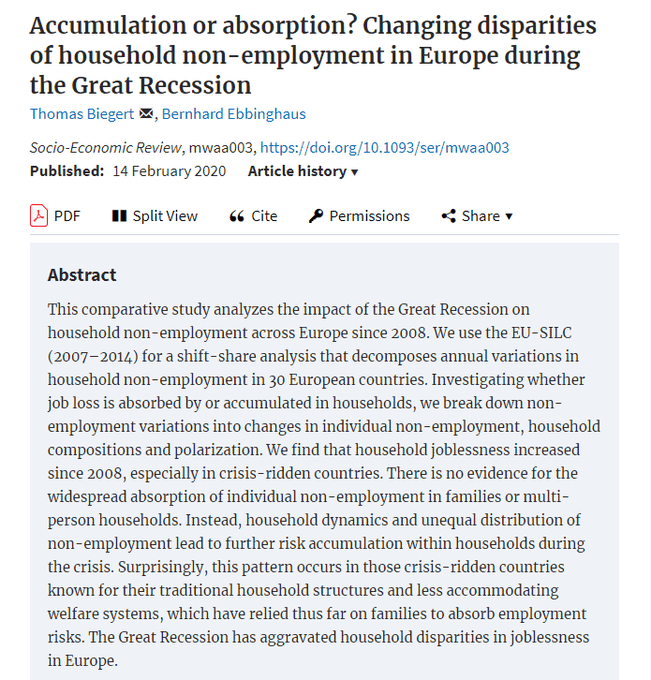
In a new article in Socio-Economic Review (SER), Thomas Biegert (LSE, @thomasbiegert) and Bernhard Ebbinghaus (Oxford U., @B_Ebbinghaus) analyse whether the individual job loss since the Great Recession was absorbed or accumulated in households. They use EU-SILC data for 30 European countries and shift-share analysis to decompose the change in absolute HH non-employment from 2008 up to 2014 and attribute it to the change in individual non-employment, the change in HH sizes, and the change in polarization. In almost all countries the increase in household non-employment since the crisis was exacerbated by rising polarization (i.e. unequal distribution of job-loss) and decreasing HH sizes. Particularly households in many crisis countries, especially in Southern Europe, were hit by such job-loss. This is surprising because we would have expected that in countries with traditional family models and limited welfare support households would absorb the impact of job-loss.
Professor Bernhard Ebbinghaus presented his comparative analysis on reproducing inequalities and poverty risks in old age pension income across Europe at the Finnish Centre for Pensions in Helsinki as part of their ETK Research seminar on Pension reforms, non-standard work and life course inequalities in the OECD.
There has been much discussion recently of pension sustainability, in the face of demographic ageing. But there has been relatively little exploration of whether retirement income is enough for people’s basic needs – and there is growing evidence of an increase in old age poverty in many European countries.
Different pensions systems are in use across Europe – some are not always capable of effectively reducing poverty despite the explicit goal to do so, and some are better suited to reduce poverty. Professor Ebbinghaus’ research finds that the elderly are more at risk of poverty than the working population. The exceptions are some Nordic pension systems such as Finland, a few central European countries as well as the Dutch multipillar system. Overall there is still considerable variation across Europe in the reproduction of income inequality, and poverty risks from working lives into old age retirement income, particularly for social risk groups such as those with non-standard working lives.
Find out how he answered the underlying question: ‘Do you think pension systems should even out the inequalities of labour market?’ in this short YouTube interview.






 Bernhard Ebbinghaus